
Home / Small molecules / Drug product / Parenteral / Development
Parenteral Formulation Development
Solution or lyophilized, suspension or emulsion, and whether an advanced formulation is needed at all.
The parenteral questions
For injectables, the questions are different from oral: solution or lyophilized powder, suspension or emulsion, and whether an advanced formulation — liposome, lipid nanoparticle, nanoparticle — is needed at all. All of these formats are developed here and manufactured on the same site network.
The pre-formulation, formulation and analytical teams are at the Shanghai Waigaoqiao and Wuxi City sites, supporting parenteral projects from preclinical studies through clinical trials to commercial launch, across small molecules, oligonucleotides, peptides and complex chemical conjugates.
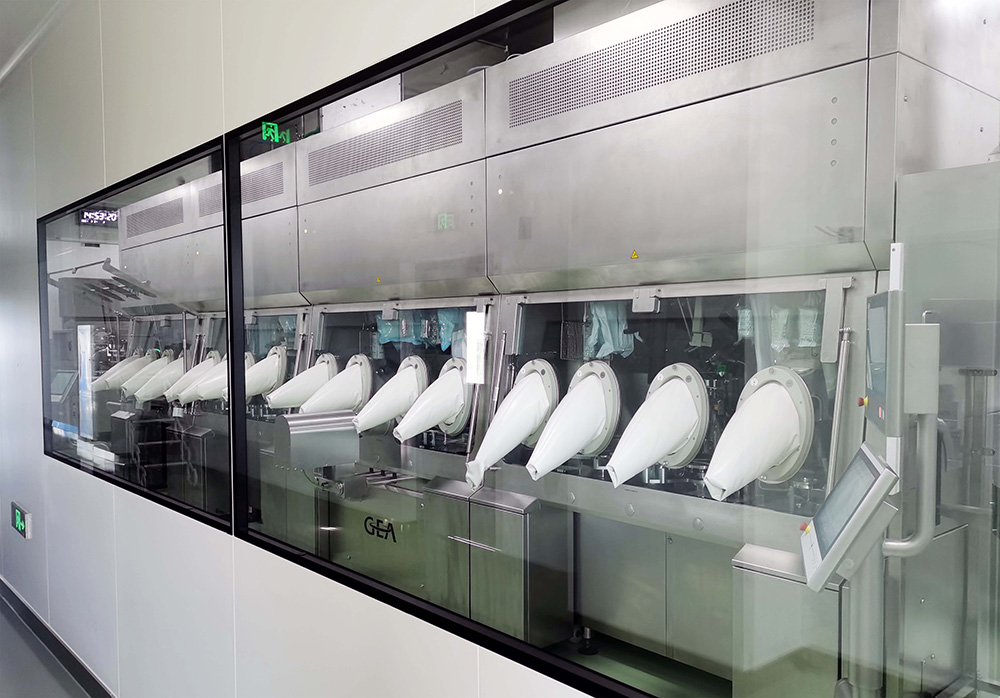
High potency injectable laboratories operate at an occupational exposure limit of 10 ng/m³.
Pre-formulation on minimal API
Developability and formulation research supports a molecule from hit to lead, through lead optimization, to candidate selection, with full physicochemical characterization on a minimal amount of API.
The team completes over 85,000 characterization tests a year on instrumentation that allows many projects to run at once.
What is tested
Physical form characterization — crystalline or amorphous, Tm, Tg and PI, water, and solvent content.
Powder property characterization — particle size, morphology, hygroscopicity.
Solubility — in pH buffer, as an in-situ salt, and in pharmaceutical vehicles including co-solvents, surfactants, and cyclodextrins.
Stability — bulk stability, solution stability under acidic, basic, oxidative and light stress, and compatibility.
High throughput screening
High throughput formulation screening uses automatic compound weighing, vehicle screening, and high throughput analysis. Sample preparation, stability study, analysis, optimization, and lead formulation selection complete within 2 weeks, against a typical industry timeline of about 4 weeks.
Dosage forms and routes
- Dosage forms: normal solution, lyophilized powder, LNP and PNP, micelle, and others
- Routes of administration: intravenous, subcutaneous, ophthalmic, intrathecal, and others
Formulation development capabilities
- Flexible batch size
- Organic solvent compounding and hydrophobic filtration, for example DMSO
- Extreme low fill volume
- High viscosity mixing and filling
- Elevated or cold temperature mixing
- Dissolved oxygen and headspace control
- Sterilization by sterile filtration, moist heat or irradiation
Case study: an oligonucleotide lyophilized drug product in six months
An oligonucleotide lyophilized drug product was developed within six months, from API process development to clinical trial supply, with drug substance, drug product and analytical workstreams running in parallel.
Case study: endotoxin control for an intrathecal oligonucleotide
An intrathecal injectable oligonucleotide was developed in sterile solution for an IND application to the US FDA, where a very low endotoxin level was required. The API team controlled endotoxin to 0.06 EU/mg and the drug product team delivered Phase I clinical supply at 0.5 EU/mL.
Lipid nanoparticle development
The LNP R&D laboratory is equipped with a multi-channel micro-mixing system, tangential flow filtration systems at several scales, sterile filtration and analytical equipment. Other mixing technologies are available, including MIVM, microfluidics, Precision Nano System and LNP extrusion. Feasibility studies, formulation development and process development are run here.