
Home / Oligonucleotides and Peptides / Drug Product / Parenteral Drug Products / Formulation Development
Development
Establish what the molecule will not tolerate before the formulation is committed.
Formulation decisions are made on very little material
Early formulation work happens when API is most scarce. A formulation decision that has to be reversed later brings new stability data requirements, comparability work, and a bridging study with it.
The first question at this stage is what the molecule will not tolerate, answered on minimal material.
Parenteral formulation development
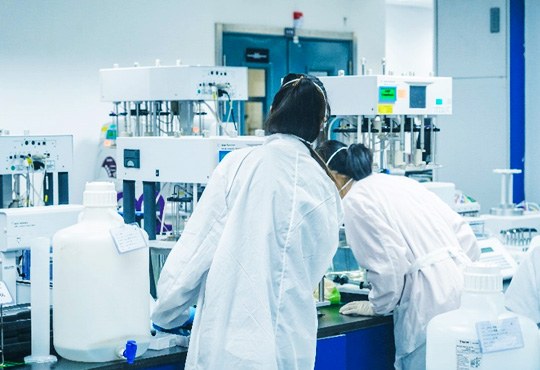
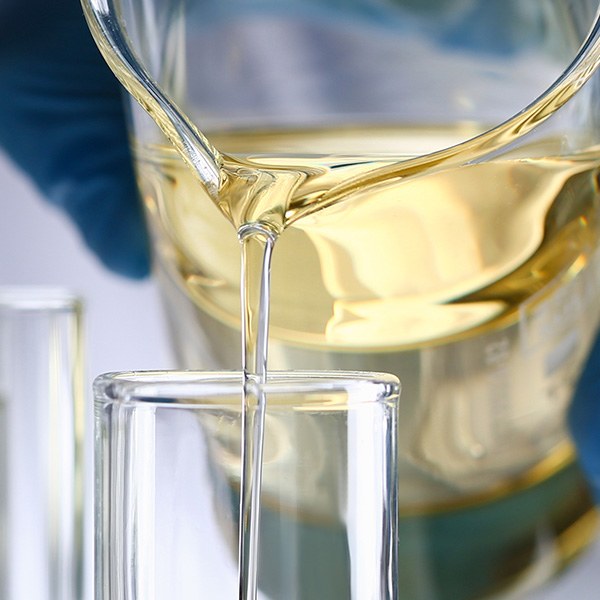
Most peptides and oligonucleotides are injectables, and the study design follows the intended route. We develop for intravenous, subcutaneous, intramuscular, intrathecal, ophthalmic and inhaled delivery, evaluating the parameters that decide an injectable: pH, osmolality, electrolyte composition and in-use stability.
That covers conventional sterile solutions and lyophilized formulations as well as the harder systems: lipid-based formulations, suspensions, and polymer- or particle-based approaches. The choice is driven by the molecule’s stability behaviour.
The pre-formulation, formulation and analytical teams are at the Shanghai Waigaoqiao and Wuxi City sites, supporting parenteral projects from preclinical studies through clinical trials to commercial launch, across all synthetic molecules — small molecules, oligonucleotides, peptides and complex chemical conjugates — with more than 85,000 characterization tests a year.
Dosage forms and filling formats
Drug types: peptide, oligonucleotide and synthetic conjugate.
Dose forms: solution, suspension and emulsion, lyophilized powder, and advanced formulations including liposomes, lipid nanoparticles and nanoparticles.
Filling formats: vials, prefilled syringes, cartridges and LDPE ampoules.
Sterilization: sterile filtration, moist-heat sterilization and irradiation.
The dosage form is an early decision
A peptide or oligonucleotide will usually end up as a lyophilized vial or a solution in a prefilled syringe. The choice determines the stability program, the fill format, the cold chain and how the product is administered, and changing it after Phase II means new stability data and a bridging study.
Made early, it is a screening exercise. Revisited after Phase II, it is a bridging study.
Lyophilization cycle development
Most peptide and oligonucleotide injectables are lyophilized, because few reach a two-year shelf life in solution.
Tray lyophilizers run from 0.5 m² to 20 m² of shelf area, with two 20 m² units on the high-potency line. That range matters because a cycle developed on a half-square-metre tray transfers to twenty square metres only through the intermediate scales, all of which are available on the platform.
Cycle development runs on the same equipment types used for commercial manufacture, so a cycle developed for clinical supply transfers without being redeveloped.
Formulated against the line that will run it
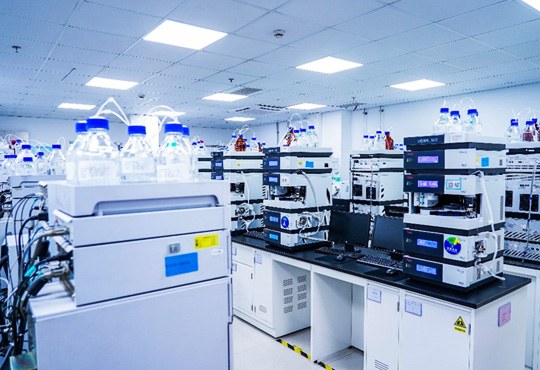
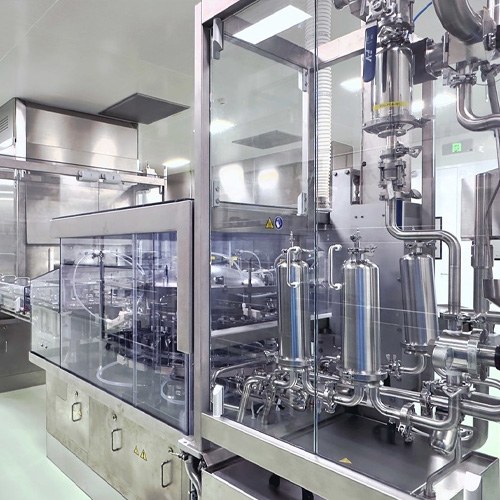
Formulation is optimized against the filling format from the start. Sterile filtration behaviour, fill format and process robustness are assessed during development, and the development laboratories are on the same Wuxi City site as the aseptic manufacturing lines.
Development also accounts for the harder handling cases the lines are built for: organic solvent compounding and hydrophobic filtration, including DMSO; extremely low fill volumes; high-viscosity mixing and filling; elevated or cold temperature mixing; and dissolved oxygen and headspace control.
Formulation optimization
Between the IND-enabling formulation and the one that will be validated, most programs make changes — to concentration, to excipient levels, sometimes to the container. Each change carries a stability obligation and a comparability question, and the aim is to make as few as possible while still arriving at a formulation that can be manufactured reliably.
IND and IMPD-enabling manufacturing
Clinical drug product development and GMP manufacture are coordinated to support toxicology studies and Phase I supply, covering manufacture, packaging, labeling and batch release in one place.
Because formulation development, analytical development and API process development run in the same program, the specification the drug product is released against is the one the drug substance was developed toward.
Related Services
Oral Peptide Delivery
Drug Product Manufacturing
Clinical Supply
CMC Development
Related content
Quantum Mechanics for Organic Chemists
Quantum Mechanics, Molecular Orbital Theory in particular, enables us to understand organic reactions at deeper levels.
Frequently Asked Questions
QM Magic Class | Chapter 38 Over the years, we received a lot of questions from our readers, below are...
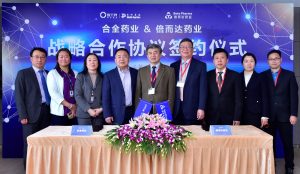
WuXi STA Forms Strategic Partnership with Beta Pharma
STA will Accelerate Process R&D and Manufacturing of Late Phase and Commercial Targets STA Pharmaceutical Co., Ltd., (WuXi STA) –...